Good grades get your application read. For some UK courses, they are not enough on their own. Medicine, law, engineering, maths, economics and computer science at many of the most competitive universities also ask you to sit an admissions test. Universities use these tests to decide who to shortlist, so missing one can rule you out however strong the rest of your application is.
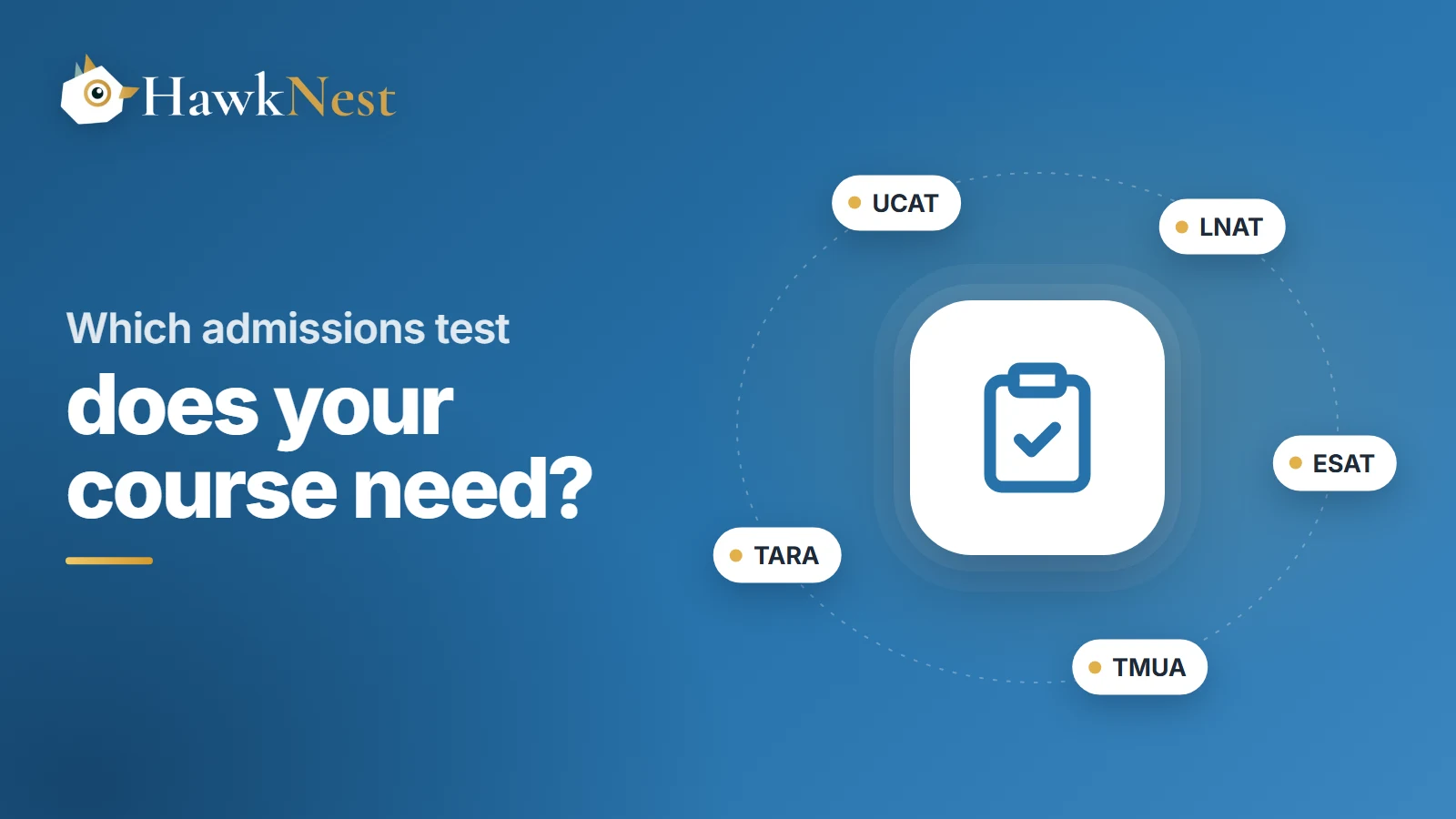
Five tests cover most cases: the UCAT, LNAT, ESAT, TMUA and TARA. This guide explains which courses ask for which, and when each one is sat. The details are for students applying in 2026 for entry in 2027.
The five tests at a glance
Test | Main courses | Format | When (2027 entry) |
|---|---|---|---|
UCAT | Medicine, dentistry | Four timed sections, just under 2 hours | 13 July to 24 September 2026 (now closed). Next window expected mid-July to late September 2027. |
LNAT | Law | 42 multiple-choice questions and an essay, 2¼ hours | From 1 September 2026; deadline depends on the university |
ESAT | Many engineering, physics and natural sciences courses, and some biology and veterinary courses | Maths plus two subject modules, 120 minutes for most | 4–8 January 2027 (the October 2026 sitting has passed). Next October sitting expected mid-October 2027. |
TMUA | Maths, computer science, economics | Two 75-minute maths papers | 4–8 January 2027 (the October 2026 sitting has passed). Next October sitting expected mid-October 2027. |
TARA | PPE and other courses at Oxford, mostly social sciences; some computer science and engineering courses at UCL | Critical thinking, problem solving and a writing task, 2 hours | 4–8 January 2027 (the October 2026 sitting has passed). Next October sitting expected mid-October 2027. |
You can sit the LNAT and each UAT-UK test only once in an admissions cycle, and a UCAT result only counts for the cycle you took it in.
UCAT: medicine and dentistry
The UCAT is used by more than 50 UK universities and medical schools, from Aberdeen to Worcester, plus seven partner universities abroad. If you want to study medicine or dentistry in the UK, expect to need it.
It has four sections: Verbal Reasoning, Decision Making, Quantitative Reasoning and Situational Judgement. You get your score report before you leave the test centre, and UCAT sends your result to your universities in early November.
Testing runs once a year, in the summer before you apply. For 2027 entry, the window was 13 July to 24 September 2026, and the booking deadline was 16 September, with no exceptions. A result only counts for the application cycle it was taken for, so you can't save one for a later year.
If you are applying for 2028 entry, expect the next window from mid-July to late September 2027. UCAT will publish the exact dates by February 2027.
LNAT: law
The LNAT is used for law at universities including Oxford, Cambridge, LSE, UCL, King's College London, Bristol, Durham and Glasgow. It takes 2¼ hours: 42 multiple-choice questions on 12 passages in 95 minutes, then one essay from a choice of three in 40 minutes. The essay isn't marked by the test centre, but it is sent to your universities with your score, and they use it alongside your application.
Testing starts on 1 September, and the last date you can sit it depends on where you apply:
Oxford and Cambridge: by 15 October 2026 (passed). For 2028 entry, expect the same deadline in October 2027.
Oxford's Foundation Year in Law: by 13 January 2027.
King's College London, LSE and UCL: by 31 December 2026.
Bristol and Durham: by 13 January 2027.
All other LNAT universities: by 25 January 2027.
Later deadlines usually apply only to international applicants. If you apply between mid-January and 30 June 2027, you may be able to sit it up to 31 July 2027, but check with each university first, because some may not accept a result taken that late. LNAT strongly advises applicants who aren't applying to Oxford or Cambridge to meet the January deadlines if they can, and LSE says places are rarely available after the January UCAS deadline. Don't sit it before the summer holiday of the year you apply: a result from earlier won't count.
ESAT, TMUA and TARA: the UAT-UK tests
These three are run by UAT-UK. Oxford started using them in 2026, alongside the LNAT and UCAT. All three share the same two sittings: 12–16 October 2026 (now passed) and 4–8 January 2027. Booking for October closed on 28 September. Booking for January closes on 21 December 2026. If you are applying for 2028 entry, expect the next October sitting in mid-October 2027, with booking closing in late September.
The October sitting matters most. Almost all Oxford and Cambridge applicants must take their test in October. The only exceptions are mature applicants to a Cambridge mature college with a January deadline, and applicants to Oxford's Astrophoria Foundation Year. For other universities you can choose either sitting, and UAT-UK says neither gives you an advantage.
ESAT
The ESAT has five 40-minute modules of 27 multiple-choice questions each. Everyone takes Mathematics 1. Most courses then ask for two of Biology, Chemistry, Physics and Mathematics 2.
Cambridge: Engineering, Natural Sciences, Chemical Engineering and Biotechnology, and Veterinary Medicine.
Oxford: Engineering Science, Physics, Physics and Philosophy, and Biomedical Sciences.
Imperial: most of its engineering courses, Physics, and its life sciences courses. Some departments, including Chemistry, Materials and Bioengineering, ask for no test.
UCL: Electronic and Electrical Engineering.
TMUA
The TMUA is two 75-minute maths papers of 20 multiple-choice questions each. One tests whether you can apply what you know; the other tests mathematical reasoning. UAT-UK says seven universities use it, including:
Cambridge: Mathematics, Computer Science and Economics. Computer Science at Peterhouse and Trinity also sets its own test, the CSAT.
Oxford: Mathematics, Computer Science and the joint courses with either.
Imperial: Mathematics, Computing and the related courses.
LSE: required for Economics, and Econometrics and Mathematical Economics, and recommended for its other maths-based courses on the UAT-UK list.
Warwick: Mathematics (where STEP is an alternative), Computer Science and Discrete Mathematics. Applicants eligible for a contextual offer are exempt. For Economics, Mathematics and Statistics, and MORSE, it is optional or recommended.
UCL: Economics.
TARA
The TARA has three 40-minute modules: Critical Thinking, Problem Solving, and a Writing Task (one essay of up to 750 words, chosen from three). The writing isn't scored; it goes to your universities to read.
Oxford: PPE, Economics and Management, History and Economics, History and Politics, Human Sciences, Philosophy and Linguistics, and the psychology courses.
UCL: some computer science, engineering and robotics courses.
What about Oxford and Cambridge humanities?
Oxford uses the TARA for several courses, mostly in the social sciences, and UCAT and LNAT for medicine and law. Cambridge sets its own written assessments for many arts and humanities courses, taken through your college, and you don't need to register for them in advance. Some Cambridge courses, such as Archaeology, Education and History of Art, have no assessment at all. Check your course page for the details.
Outside the UK
Italy: English-taught medicine at Italy's public universities uses the IMAT, set by the Italian Ministry of University and Research. In 2026 it was held in late September.
Ireland: undergraduate medicine uses the HPAT-Ireland, held each February. International (non-EU) applicants may be exempt, so check with each university.
The US: universities don't use course-specific tests like these. Each sets its own policy on the SAT or ACT. Some require a score, some make it optional, and the rules change, so check each university's admissions page.
How to check your own course
Open the course page on the university's website and find the entry requirements.
Look for an "admissions test" line. If there isn't one, that course doesn't need any of these tests.
Check the test's own website for the dates, and book early. Each test has a booking deadline, and the UCAT, for one, makes no exceptions.
Common questions
Can I take the same test twice?
Not the LNAT or the UAT-UK tests: each allows one sitting per admissions cycle. A UCAT result only counts for the cycle you took it in. If you reapply the following year, you sit the test again.
I'm applying to both Oxford and Imperial for engineering. Do I sit the ESAT twice?
No. You can only sit it once in a cycle, so take it in October, as Oxford requires, and the same result counts for both applications. Book every module that either course needs, because you can't add or change modules after booking.
What happened to the BMAT?
It was withdrawn in 2024, as Imperial and UCL both note on their own pages. For medicine, Oxford, Cambridge, Imperial and UCL now use the UCAT.
Not sure which course to aim for yet? The HawkNest career assessment suggests courses that suit you. HawkNest then checks the entry requirements of the courses you choose and builds the tests and deadlines into your plan. For when to start preparing, see When to start preparing for the SAT, UCAT and IELTS.
Sources: UCAT universities, test format, test dates and results; what the LNAT is, test format, dates and deadlines and when to take it; UAT-UK pages for the ESAT, TMUA, TARA and deadlines, and its 2027 course list; University of Oxford, admissions tests; University of Cambridge, admission tests and assessments; Imperial College London, admissions tests; LSE, how to apply; University of Warwick, admissions tests; Imperial School of Medicine, FAQs; UCL Medical School, selection procedure; University of Messina, IMAT; ACER, HPAT-Ireland. Checked in October 2026.