Part of our series What does a ___ actually do?, plain-English guides to the careers students ask us about most.
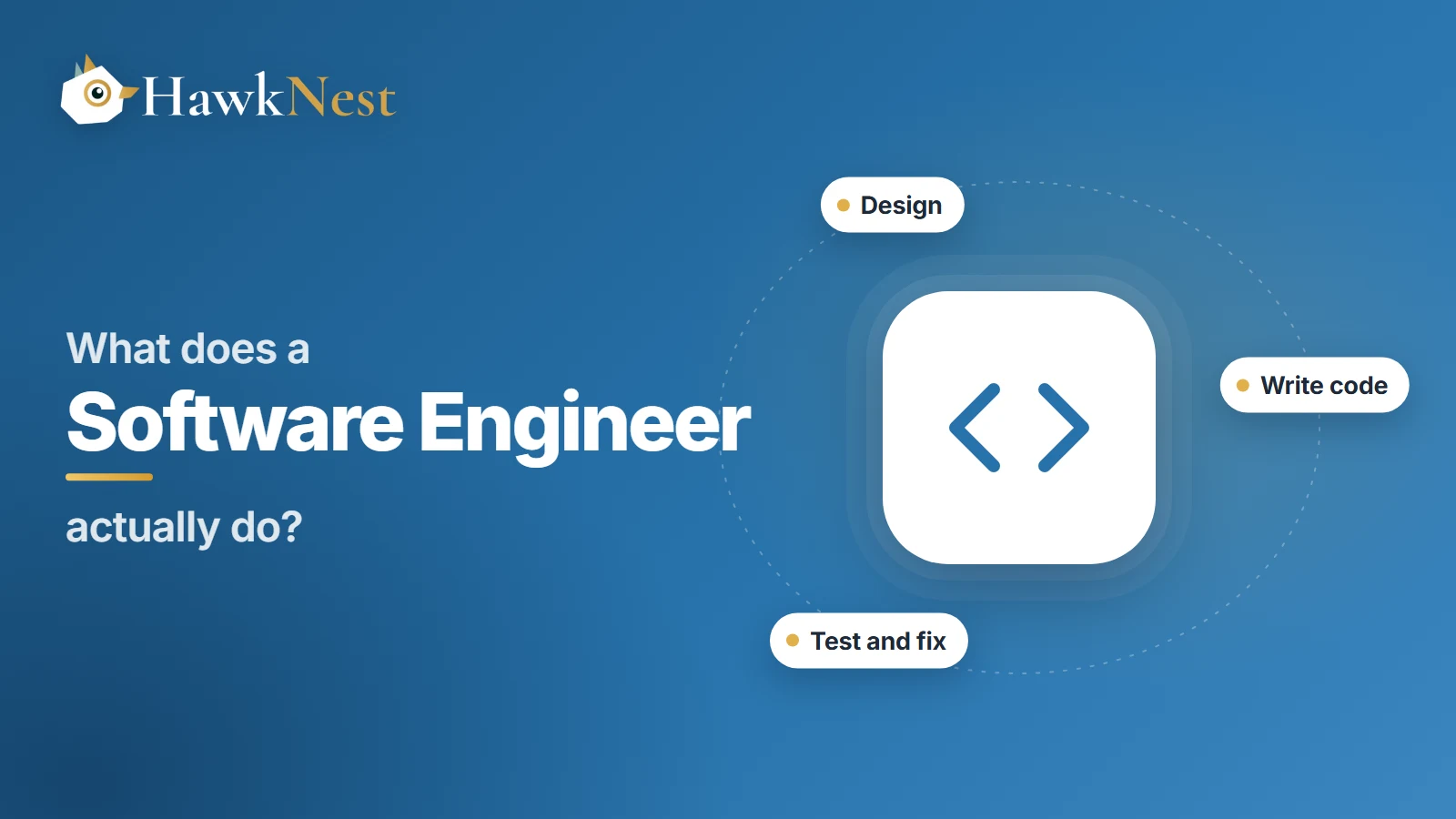
A software engineer designs, builds and maintains the programs we use every day, from banking apps to hospital systems to games. Writing code is only part of it. Much of the job is working out what people need, planning how to build it, and testing it until it works reliably.
What the job involves
Discussing what a client or team needs, and whether it can be built in the time and budget available.
Planning designs and timescales with a technical team.
Writing new code and updating existing code.
Testing software at each stage to find and fix problems.
Improving existing software so it runs faster or works with new hardware.
Recording changes and the reasons for them, and running final checks before release.
Supporting systems once they are live.
A typical day
Many teams start with a short meeting to share progress and flag anything blocking them. Most of the day is focused work: building a new feature, tracking down a bug or reviewing a teammate’s code before it goes live. There are usually conversations with designers, product managers or clients about how something should behave, and tests to write so that the next change does not break what already works.
It is mostly desk-based. In the US occupational survey, 95% of software developers said they spend most of their time sitting, and 71% said working as part of a team is extremely important.
Where they work
Software engineers work for technology companies and also for banks, airlines, hospitals, governments and startups: almost every organisation now runs on software. You could work in an office, from home or at a client’s business. In the UK, typical hours are 37 to 40 a week, with occasional evening or weekend work when a launch or a fault needs attention.
Is it a good fit for you?
Software engineering mixes the Investigative interest type (analysing problems and working out solutions) with the Conventional one (working carefully, following processes, keeping things organised). You might enjoy it if you:
Like maths, logic puzzles or taking things apart to see how they work.
Do not give up when something does not work the first time.
Enjoy building something that other people use.
Can explain technical ideas to people who are not technical.
Common tools include programming languages such as TypeScript and Java, frameworks such as React, databases such as PostgreSQL, and version control with Git.
How to become a software engineer
Route | What it involves |
|---|---|
University degree | Computer science, software engineering, IT or maths. The most common route: most US software developer jobs ask for a four-year bachelor’s degree. |
Degree apprenticeship (UK) | Work and study at the same time, for example the Digital and Technology Solutions Professional Level 6 degree apprenticeship. |
College course | Computing or programming qualifications, such as the T Level in Digital Software Development. |
Graduate scheme | Some IT companies train graduates of any subject. |
In the UK, a degree usually needs 2 to 3 A levels or equivalent. Maths is the most useful subject to keep, and computer science helps if your school offers it.
Where to study in the GCC
A selection of computer science degrees in the region, with details from each university’s official programme page.
University | Programme | What the university states |
|---|---|---|
BS in Computer Science | Accredited by the UAE Commission for Academic Accreditation and by ABET’s Computing Accreditation Commission | |
Khalifa University, Abu Dhabi | BSc in Computer Science | Concentrations in AI and cybersecurity |
Computer Science (BS) | 128 credits | |
BS in Computer Science | 4 years | |
BSc (Hons) Computer Science (Software Engineering) | 3 to 4 years | |
KFUPM, Saudi Arabia | BS in Computer Science | Accredited by ABET’s Computing Accreditation Commission |
Top universities worldwide
Looking beyond the Gulf? These are the top eight for computer science and information systems in the QS World University Rankings by Subject 2026.
Rank | University | Country |
|---|---|---|
1 | Massachusetts Institute of Technology (MIT) | United States |
2 | Stanford University | United States |
3 | Carnegie Mellon University | United States |
=4 | National University of Singapore (NUS) | Singapore |
=4 | University of Oxford | United Kingdom |
6 | University of California, Berkeley | United States |
7 | Harvard University | United States |
8 | University of Cambridge | United Kingdom |
Most of these admit undergraduates directly into computer science. Expect very high maths grades and, in the UK, admissions tests at some of them. Rankings mostly reflect research reputation, so read them alongside the course details.
What software engineers earn
From official government wage statistics, converted to US dollars and rounded:
Country | Lower end | Upper end |
|---|---|---|
United States | $82,000 | $215,000 |
United Kingdom | $43,000 | $136,000 |
Canada | $51,000 | $133,000 |
The figures run from the 10th to the 90th percentile of earners. No GCC government publishes pay by job title, so we don’t show regional figures.
Try it now
Try a virtual internship. A Learning Lab’s AI and Computer Science Virtual Internship covers coding, Python and machine learning through real technology projects.
Build something small. A simple website, a calculator app or a game teaches more than any tutorial.
Learn the basics of Git and keep your projects online. A portfolio of real projects helps university and internship applications.
Enter a competition. Coding and technology challenges, including UniHawk’s competitions, show initiative.
Frequently asked questions
Is a software engineer the same as a software developer?
The titles are often used for the same job. Some employers use “engineer” for roles with more system design and “developer” for roles focused on building features, but the day-to-day work overlaps heavily.
Do I need to be brilliant at maths?
You need to be comfortable with logical thinking, and maths is the most useful school subject to keep. Some areas, such as graphics, AI or data, need more advanced maths than others.
Can I become a software engineer without a degree?
Yes. In the UK there are apprenticeships at several levels, and some employers hire people who can show strong skills through their own projects. A degree is still the most common route.
Wondering whether tech is right for you? The HawkNest career assessment matches your interests and strengths to careers like this one.
More in this series
Sources: O*NET OnLine, Software Developers; National Careers Service, Software developer; pay from US BLS (May 2025), UK ONS ASHE (2025) and Canada Job Bank (2025), converted at ECB rates of 1 October 2026.